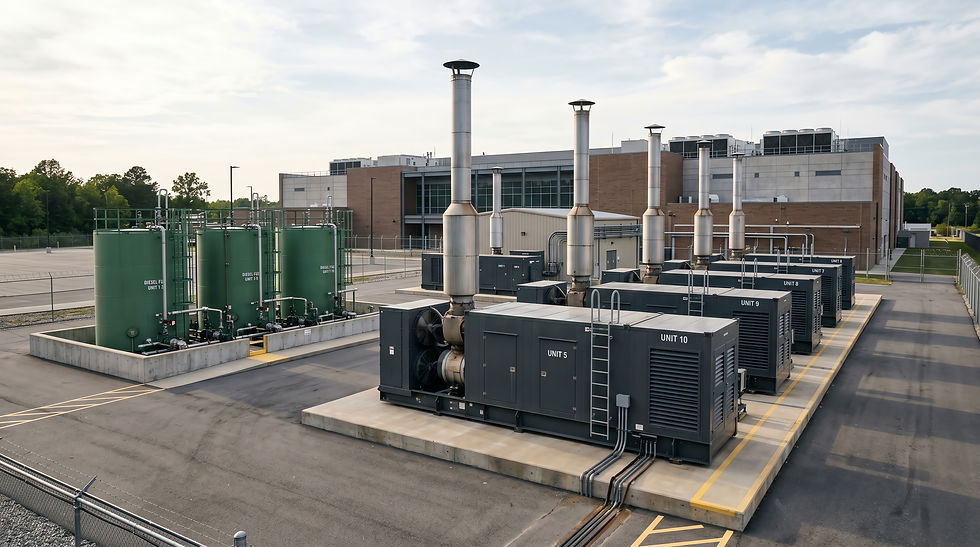
How Backup Power Works in Data Centers

How Data Centers Stay Online During Power Outages
When analyzing critical facilities, structural engineers and operators must confront the realities of utility grid volatility. Data centers must operate continuously without even a momentary interruption. In a world driven by hyperscale architectures and high-density environments, a power disruption lasting a mere fraction of a millisecond can corrupt files, disrupt cloud-based enterprise applications, and cause catastrophic financial and reputational revenue damage.
To neutralize this threat, modern infrastructure relies on a highly sophisticated sequence of backup power assets. These systems are engineered to provide both immediate safety and sustained energy generation, ensuring a seamless transition between power sources. Rather than relying on a single piece of machinery, data center reliability is achieved through a layered approach designed to eliminate single points of failure.
At Enercon, we specialize in the design and integration of mission-critical infrastructure solutions, ensuring that every layer of the emergency electrical chain functions as a unified, resilient system.

What Is a Backup Power System in a Data Center?
A backup power system in a data center is a combination of electrical systems designed to provide immediate and sustained power when utility power is interrupted, ensuring continuous operation of critical infrastructure.
It is a common misconception that backup power simply means an emergency engine sitting outside a building. In reality, a true high-availability setup is an integrated, automated ecosystem comprising:
Uninterruptible Power Supply (UPS) systems to handle immediate, transient anomalies.
Heavy-duty standby generators to manage continuous, long-term electricity production.
Intelligent transfer switches and control networks to orchestrate energy pathways.
Every individual component is built for instant response, completely automatic operation, and uncompromised power continuity, maintaining system availability regardless of the state of the municipal utility grid.
The Backup Power Sequence: Step-by-Step
The shift from standard grid utility power to on-site emergency generation is a tightly choreographed, automated routine known as the failover process.
Utility Power Failure Detection: Instantaneous.
The moment utility voltage drops below a safe operational threshold, or cuts out entirely, high-speed digital monitoring systems detect the anomaly instantly and trigger the failover sequence.
UPS Provides Immediate Power: 0 to 2 milliseconds.
Because massive diesel engines require several seconds to spin up, the battery-backed UPS systems assume the electrical load instantly. This bridges the gap perfectly, ensuring zero power interruption to sensitive server racks.
Generators Start Automatically: Under 10 seconds.
Simultaneously, an automated signal is delivered to the facility's standby backup generators. The engines crank and power on, accelerating to full operational RPMs and stabilizing their voltage output within seconds.
Transfer Switches Shift Power Source: Automated.
Once the emergency generators achieve stable synchronization, industrial automatic transfer switches shift the facility's primary electrical load away from the draining UPS batteries and onto the generators.
Continuous Operation on Backup Power: Sustained.
The data center remains fully operational on localized generator power. This isolated state is maintained continuously, ensuring uptime until the public utility grid is confirmed stable for safe reconnection.

Core Components of Data Center Backup Power Systems
To achieve a fail-safe environment, specific electrical assets must be systematically integrated into the building's infrastructure:
Uninterruptible Power Supply (UPS): Serving as the first line of defense, these battery-based configurations provide immediate power backup and safeguard sensitive equipment from brief interruptions, voltage sags, and harmonic distortion.
Backup Generators: The foundation of long-duration power supply. Typically powered by diesel or natural gas, these rugged systems are packaged in protective enclosures to support extended outages lasting days or weeks.
Automatic Transfer Switches (ATS): The mechanical bridges responsible for seamless switching between power sources. They constantly monitor electrical qualities and safely redirect current without human intervention.
Fuel Systems: A highly critical sub-system consisting of day tanks, main bulk storage tanks, and automated polishing systems that ensure clean fuel availability for maximum generator runtime during extended grid emergencies.
Monitoring and Control Systems: Industrial control platforms that track real-time system performance, load distribution, and battery health, identifying potential component strains before they can manifest as infrastructure failures.
Why Data Centers Use Layered Backup Power Systems
When engineering for maximum uptime, no single asset is sufficient on its own. For instance, a UPS battery plant offers near-instantaneous activation but possesses limited run-time capacity before depleting. Conversely, an industrial engine package offers days of long-term energy generation but requires a finite period to start and accept building loads.
By layering these components into a unified, sequential infrastructure network, data centers achieve true system redundancy and operational reliability. The UPS serves as the immediate bridge, while the generators provide the sustained power engine. This structural division of labor ensures that the critical computing floor never experiences an unexpected energy drop.
What Happens If Backup Systems Fail?
Because backup systems operate in high-stakes situations, they must be insulated from internal errors. To mitigate the risk of a backup asset failing to start, data centers utilize specialized redundancy models:
N+1 Architecture: Incorporating at least one extra backup unit (such as an extra engine or UPS module) beyond what is strictly required to run the facility at full load.
2N Architecture: Fully duplicating the entire power distribution chain to create two completely parallel, independent energy pathways.
By deploying these layered redundancy frameworks alongside sophisticated electrical switchgear, modern facilities ensure that if an individual generator or UPS module encounters a fault during an outage, an alternate emergency asset is already positioned to absorb the load seamlessly.

How Backup Power Systems Are Tested
A backup power strategy is only as dependable as its most recent operational validation. True facility resilience requires rigorous, ongoing testing protocols:
Load Testing: Utilizing specialized generator docking stations to safely connect mobile load banks to the facility. This allows engineers to subject the backup generators to 100% capacity demands, validating thermal and mechanical performance without risking live IT operations.
Routine Maintenance: Performing scheduled fluid analysis, battery conductance testing, and mechanical checks to maintain complete equipment reliability.
Continuous Monitoring: Utilizing advanced control interfaces to track heater loops, fuel states, and starter battery charge levels in real-time, detecting minor equipment variations before they develop into deployment failures.
Common Backup Power Challenges in Data Centers
Operating emergency electrical infrastructure at scale introduces substantial real-world variables:
Generator Startup Timing: Engineering a flawless power handoff during the brief window between a utility failure and full generator readiness requires precision timing and low-latency control logic.
Fuel Availability and Logistics: Sustaining extended runtimes requires proactive fuel supply chain contracts and advanced monitoring to manage consumption rates under full facility stress.
Increasing Power Demand: The rapid expansion of artificial intelligence (AI) workloads is driving severe power density trends. Modern facilities require higher-capacity backup systems and low-voltage switchgear architectures engineered to manage heavy, highly localized electrical loads.
The Role of Backup Power in Data Center Resilience
Ultimately, an optimized backup power layout serves as a primary pillar of an overarching data center resilience posture. It does not exist merely to respond to rare emergency events; it is a structural asset that facilitates continuous preventative maintenance, supports scalable infrastructure growth, and guarantees total operational continuity. By blending high-performance medium-voltage switchgear with automated emergency generation, data centers convert volatile incoming utility energy into a controlled, completely reliable on-site microgrid.
FAQs About Backup Power in Data Centers
How do data centers stay powered during outages?
Data centers utilize a synchronized system combining battery-based UPS configurations and industrial standby generators. The UPS instantly bridges the initial utility drop, while automated generators power on within seconds to handle long-term electrical demands.
How fast do backup power systems activate?
Activation occurs nearly instantly. The UPS system transfers to battery power with zero propagation delay (typically within 0 to 2 milliseconds), while standby generators are designed to start up, stabilize, and accept the building load in under 10 seconds.
Why do data centers use both UPS and generators?
They fulfill distinct roles within the failover chain. UPS modules are engineered for instantaneous, short-duration power filtering and bridging, whereas generators are optimized to deliver sustained, high-capacity electricity for the duration of extended grid outages.
What is failover in a data center power system?
Failover is the automated transition sequence where an infrastructure network detects a fault on its primary utility line and automatically re-routes electrical distribution paths to active on-site emergency backup assets without disrupting operations.
Standby systems undergo routine monthly diagnostic starts, complemented by rigorous annual or semi-annual load bank testing. This consistent testing ensures all components perform optimally under full mechanical and thermal strain.
Partnering for the Future of High-Density Infrastructure
The move toward high-density computing is inevitable, but the path to a reliable, scalable facility is paved with complex engineering decisions. As AI workloads and high-performance computing continue to push the boundaries of traditional data center design, you need a partner who understands the delicate equilibrium between power distribution and thermal management.
At Enercon, we don't just provide components; we deliver integrated solutions designed for the most demanding mission-critical environments. From custom switchgear that handles massive amperage to backup systems engineered for instant resiliency, we help you navigate the transition from legacy air-cooled rooms to the liquid-cooled, high-density hubs of tomorrow.
Ready to future-proof your facility? Learn how Enercon supports reliable backup power systems that ensure continuous uptime in mission-critical data center environments. Consult with our experts today.