Microgrids in Data Centers: A Future-Proof Power Strategy

Why Data Centers Are Rethinking Power Strategy
As global computing demands expand exponentially, data center operators and facility engineers are forced to re-evaluate traditional power architecture models. At the same time, modern data centers are encountering a perfect storm of operational challenges, including:
Unprecedented power demand driven by rapid, high-density computing deployments.
Severe grid reliability concerns, including utility capacity bottlenecks and aging public infrastructure.
Mounting energy cost pressures and volatile peak-demand utility rates.
Relying purely on traditional, grid-dependent power models is becoming a riskier proposition. To secure uninterrupted operational continuity, data centers are shifting toward proactive, resilient, and flexible power management strategies.
Microgrids provide facilities with localized control, enhanced operational resilience, and total energy flexibility. At Enercon, we specialize in advanced power infrastructure engineering, delivering custom electrical architectures that allow mission-critical environments to scale safely alongside evolving energy demands. For a comprehensive overview of how power moves through the facility, explore our complete guide to data center power infrastructure.
What Is a Microgrid in a Data Center?
A microgrid in a data center is a localized energy system that can operate independently or alongside the main power grid, using a combination of on-site power generation, energy storage, and intelligent control systems to ensure a reliable, continuous electricity supply.
Unlike a standard emergency backup layout that sits idle until a blackout occurs, a data center microgrid actively manages energy assets every day. It can operate seamlessly in two primary modes:
Grid-Connected Mode: Interfacing with the primary utility grid while balancing localized generation and storage to optimize costs and power quality.
Islanded (Independent) Mode: Disconnecting completely from the utility grid during an outage, power disturbance, or localized surge, relying entirely on self-contained, on-site energy assets.
Why Data Centers Are Adopting Microgrids
The shift toward distributed energy architectures is driven by distinct operational and economic catalysts:
Increasing Power Demand
The explosion of AI workloads, machine learning, and high-performance computing has dramatically increased per-rack energy requirements. Microgrids give facilities the localized power capacity needed to support these high-density environments without waiting years for utility substation upgrades.
Grid Reliability Concerns
Municipal power grids face increasing strain from severe weather events, capacity constraints, and infrastructure aging. A microgrid safeguards a data center from external volatility by enabling complete grid independence on demand.
Energy Cost Management
By leveraging on-site generation and battery storage during peak utility pricing windows (peak shaving), facility operators can bypass expensive peak-time rates and significantly lower total operational expenses.
Sustainability Goals
Microgrids provide the structural foundation needed to integrate clean, on-site energy solutions—such as solar arrays, fuel cells, or wind resources—directly into the facility's power architecture.
How Microgrids Work in Data Centers
A data center microgrid functions as a dynamic, synchronized energy ecosystem composed of four key building blocks.
On-Site Power Generation
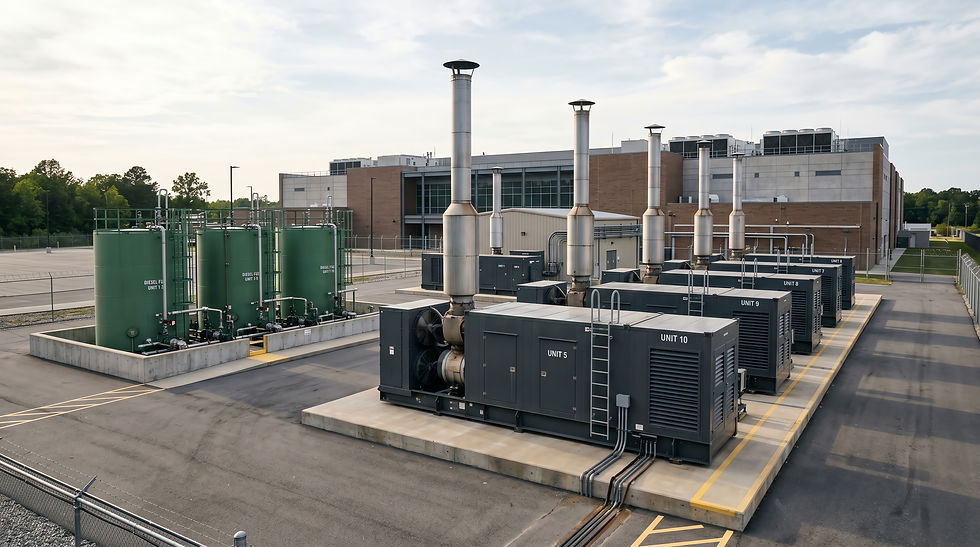
Combines traditional standby diesel or natural gas engines with renewable power sources, fuel cells, or microturbines to generate continuous electricity locally. Discover how emergency power generators are integrated into facilities in our overview on the role of critical backup power in data centers.
Energy Storage Systems (BESS)
Industrial battery energy storage systems capture surplus power during low-demand periods and release it instantaneously during load surges or grid dropouts, ensuring seamless frequency regulation and power quality.
Control Systems
The "brain" of the microgrid. Intelligent automation algorithms continuously monitor utility stability, fuel reserves, battery state-of-charge, and server loads, automatically directing power traffic to maximize efficiency and uptime. Managing these complex power handoffs requires specialized custom electrical control systems built for mission-critical reliability.
Grid Integration
Advanced high-voltage switchgear and transfer controls connect the microgrid to the main municipal grid, allowing the facility to import, export, or isolate power fluidly without disrupting server operations.
Microgrids vs. Traditional Backup Power Systems
Feature / Metric | Microgrid System | Traditional Backup System |
Operational Strategy | Proactive, continuous energy management | Reactive (activates onlyduring power outages) |
Grid Interaction | Can operate parallel to or independent from grid | Fully dependent on the grid until a failure occurs |
Asset Utilization | Active daily (peak shaving, load balancing) | Idle asset (used exclusively for emergencies) |
Renewable Integration | Seamlessly integrates renewables & storage | Primarily relies on fossil-fuel generators |
Long-Term Flexibility | Modular, scalable, and future-ready | Fixed capacity tied to specific engine footprints |
While traditional systems sit waiting for a disaster, a microgrid dynamically shapes a data center's energy profile every single day.
Benefits of Microgrids in Data Centers
Improved Operational Resilience: By eliminating single points of utility failure, facilities can withstand extended regional blackouts without compromising uptime SLAs.
Power Flexibility: Operating multiple, diversified power sources prevents a failure in any single fuel or utility supply line from taking down the compute floor.
Cost Optimization: Intelligent software dispatches energy from on-site storage or generators when utility electricity prices spike, reducing total facility power costs.
Seamless Sustainability Integration: Facilities can integrate localized solar, wind, or low-carbon fuel sources directly into their primary power distribution matrix, accelerating corporate ESG compliance.
Challenges of Implementing Microgrids
Transitioning to a decentralized power strategy requires addressing real-world engineering constraints:
Infrastructure Complexity: Combining variable power sources, energy storage, and traditional utilities into a single, cohesive topology requires advanced mechanical and electrical integration.
Initial Capital Investment: The upfront CapEx for microgrid controls, battery energy storage systems, and advanced switchgear is higher than standard standby generator setups.
System Management & Monitoring: Operating an on-site power plant requires continuous digital monitoring, predictive maintenance, and specialized field expertise. Incorporating comprehensive preventative maintenance and testing keeps protective relays, controls, and switchgear operating properly. For brownfield sites expanding their energy architecture, utilizing switchgear retrofit and modernization provides a cost-effective route to integrate microgrid control logic without replacing existing electrical enclosures.

When Data Centers Should Consider Microgrids
While not every low-density facility requires a dedicated microgrid, adoption is becoming essential under specific operational conditions:
High-Density & AI Environments: Facilities supporting high-power-density GPU racks that demand immense, continuous localized power.
Regions with Unreliable Grids: Facilities built in markets experiencing utility capacity shortages, long interconnection wait times, or frequent blackout events.
Sustainability-Driven Operations: Sites bound by strict carbon-reduction mandates that require on-site clean energy generation and energy storage.
Microgrids and the Future of Data Center Power
Decentralized, localized energy management is rapidly becoming a core pillar of modern data center infrastructure.
As artificial intelligence workloads drive power densities to unprecedented levels, waiting years for public utility companies to build new substations is no longer a viable growth strategy. Microgrids empower data center operators to build self-sustaining, future-proof facilities that generate, store, and manage their own power. Combined with modern thermal management setups and data center genset packaging solutions, microgrids represent the next evolution in resilient, scalable infrastructure.
FAQs About Microgrids in Data Centers
What is a microgrid in a data center?
A microgrid is a localized energy system that combines on-site power generation, battery storage, and intelligent control systems. It can operate alongside the main grid or isolate completely to supply continuous electricity independently.
How do microgrids improve data center reliability?
They remove complete dependence on the municipal grid. If the main utility line fails or suffers a voltage sag, the microgrid automatically islands the facility, maintaining smooth operations via on-site power and energy storage.
Can a data center run entirely on a microgrid?
Yes. In "island mode," a well-designed data center microgrid can continuously power the entire facility using a combination of on-site generators, battery arrays, and renewable resources without taking any power from the utility grid.
How are microgrids different from backup generators?
Backup generators are reactive systems that sit idle until an outage occurs. A microgrid is an active, integrated system that continuously manages, stores, and optimizes energy flow daily to lower costs and ensure resilience.
Do microgrids support renewable energy in data centers?
Yes. Microgrids are specifically engineered to integrate clean energy sources like solar panels, wind turbines, and hydrogen fuel cells alongside battery storage, reducing reliance on fossil fuels and municipal power lines.
Partnering for the Future of High-Density Infrastructure
The move toward high-density computing is inevitable, but the path to a reliable, scalable facility is paved with complex engineering decisions. As AI workloads and high-performance computing continue to push the boundaries of traditional data center design, you need a partner who understands the delicate equilibrium between power distribution and thermal management.
At Enercon, we don't just provide components; we deliver integrated solutions designed for the most demanding mission-critical environments. From custom switchgear that handles massive amperage to backup systems engineered for instant resiliency, we help you navigate the transition from legacy air-cooled rooms to the liquid-cooled, high-density hubs of tomorrow.
Ready to future-proof your facility? Learn how Enercon supports advanced power strategies, including microgrid integration for resilient, mission-critical data center solutions. Consult with our experts today.